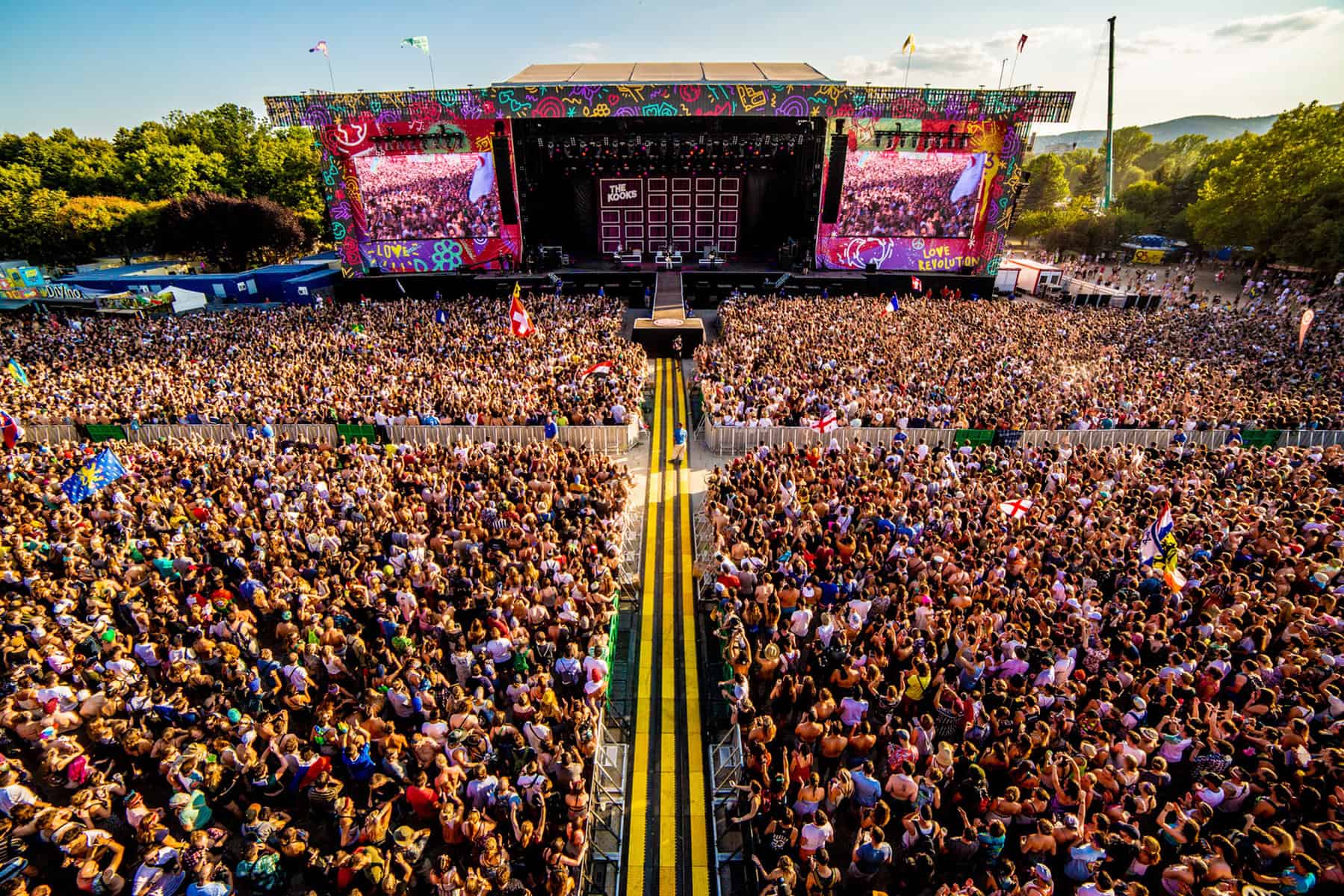
There are festivals you attend for a weekend.
And then there are festivals where you temporarily forget what day it is, what city you're in, and what you were supposed to be doing in the first place.
Sziget is the second kind.
Every August, Budapest's Óbuda Island becomes a temporary city of music, art, performance, nightlife and discovery.
And while the festival can bring some of the biggest names in the world to its stages, that's not the reason we're putting Sziget on the CÜÜLtura radar.
We're interested in what happens between the headliners.
DON'T JUST GO FOR THE HEADLINER
Sziget's 2026 program featured artists ranging from massive international names to electronic acts and emerging artists, but music is only one piece of the experience.
The festival also programs theater, circus, dance, workshops, art installations, interactive experiences and more.
That matters.
Because we're starting to question the idea that a festival should simply be a giant concert venue with camping attached.
What if the festival itself is the destination?
What if the best memory isn't the artist you traveled thousands of miles to see?
What if it's the performance you accidentally discovered at 2 p.m.?
The artist whose name you couldn't pronounce.
The weird installation you found while looking for food.
The conversation with someone from another country.
The tiny stage you wandered into at 4 a.m.
That's where Sziget gets interesting.
A CITY INSIDE A CITY
For several days, the island becomes its own world.
Sziget encourages visitors to stay on the island, but it also positions the festival as a reason to explore Budapest itself. The festival describes the city as a mixture of history, contemporary culture, nature and nightlife, making the trip feel more like a festival holiday than simply flying in for a concert.
And that's something we love.
Travel for the culture, not just the lineup.
Go to Budapest.
Eat something you've never tried.
Walk somewhere you didn't plan to go.
Find a record store.
Get lost.
Then go back to the island.
The festival becomes part of the trip instead of the entire reason for it.
THE ELECTRONIC SIDE
For our readers coming from the house, techno and underground world, Sziget has another reason to investigate.
The 2026 edition introduced the Delta District, specifically expanding the festival's electronic-culture programming.
One of its centerpiece spaces, the Yettel Colosseum, is a 360-degree electronic venue built from thousands of wooden pallets and designed as an immersive arena for house and techno. Its 2026 programming included artists such as Richie Hawtin, Dixon, Joris Voorn, Héctor Oaks, HAAi, Pan-Pot, Patrick Mason, Tiga, X-Coast and many others.
This is the kind of thing we mean when we tell people:
Look beyond the main stage.
The giant headliner might be what gets you there.
But the side stages can be what makes you stay.
THE POINT IS FREEDOM
Sziget calls itself The Island of Freedom.
That's a big statement.
But freedom doesn't necessarily mean doing whatever you want.
Sometimes freedom means having enough space to discover something you didn't know you wanted.
A festival can give you that.
You can spend the morning at a workshop.
The afternoon watching a circus performance.
The evening dancing to a band you've never heard.
Then disappear into an electronic stage until sunrise.
There's no requirement that your experience look like anyone else's.
And maybe that's the real luxury.
Choice.
CULTURE BEYOND MUSIC
This is another reason Sziget caught our attention.
The festival isn't only presenting performers.
It's creating opportunities for cultural exchange.
Its Changemakers program has included projects centered around cultural diversity, community, intercultural experiences, sustainability and social impact.
Sziget also publishes sustainability goals around reducing its environmental impact and using festivals as temporary communities where new behaviors and ideas can be tested.
We're not saying that makes the festival perfect.
No festival is.
But these are the kinds of things we want to investigate.
What is the event actually trying to create?
Not just:
Who is playing?
THIS IS WHAT WE MEAN BY FESTIVAL RADAR
We're not building a list of the biggest festivals in the world.
We're building a map for people who are willing to look sideways.
The festivals where you can still discover something.
The events where the lineup is only the beginning.
The places where music overlaps with art, travel, community and strange experiences.
The destinations that make you come home with stories instead of just videos.
Sziget belongs on that map.
GO LOOKING
If you travel to Budapest for Sziget, don't spend the entire week staring at the festival schedule.
Leave room for accidents.
Miss a set.
Follow a sound.
Talk to someone.
Walk somewhere you've never been.
Go into the tent that looks weird.
Watch something you don't understand.
Dance with people whose language you don't speak.
Then come back and tell us what you found.
Because that's what we're looking for.
Not another festival where everyone saw the same thing.
We want the festival where everyone came home with a different story.
CÜÜLtura Festival Radar
Sziget — Budapest, Hungary
Don't just follow the lineup.
Follow your curiosity.