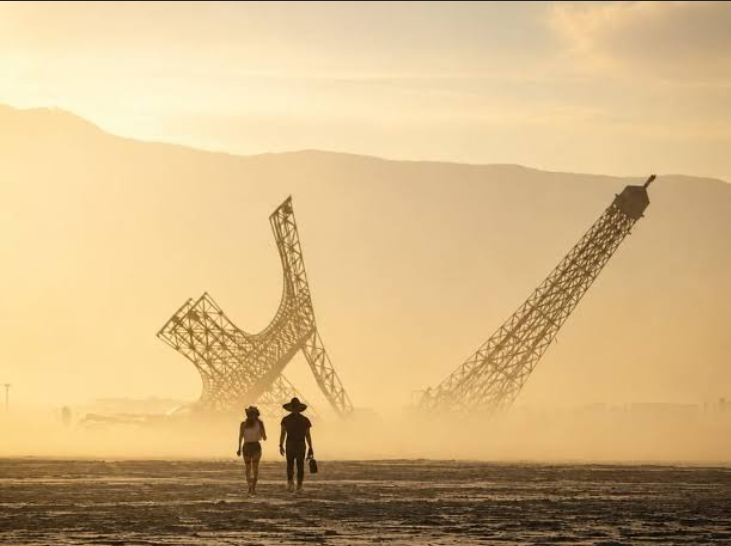
There was a time when Burning Man felt like a secret.
Not because nobody knew about it.
But because the people who went seemed to understand something that couldn't really be explained to everyone else.
You didn't go to Black Rock City to be seen.
You went to disappear.
You went to build.
To create.
To give.
To wander into the desert without knowing what you were going to find.
You could spend days following music, art, fire, strangers, dust and intuition.
There was no VIP section waiting to tell you where you belonged.
The experience was the point.
And for many of us, that was the magic.
We loved Burning Man.
And that's exactly why we're willing to ask the uncomfortable question:
What happened to the soul?
THIS ISN'T AN ATTACK ON BURNING MAN
Let's make something clear.
This isn't a piece written by people who never understood Burning Man.
Quite the opposite.
We understand why people fell in love with it.
We understand why artists built impossible machines in the desert.
Why people spent months constructing camps.
Why strangers gave things away.
Why people rode bicycles through dust storms searching for something they couldn't put into words.
Why a temporary city could feel more alive than permanent cities.
That's the part we still believe in.
The problem isn't that Burning Man became popular.
The problem is what happens when the culture becomes the commodity.
Burning Man's own principles were built around ideas like radical inclusion, gifting, participation and decommodification. Its cultural guidance explicitly warns against turning participation, art and human connection into something that can simply be bought.
And yet today, even some of the people who helped create Burning Man are questioning how far the event has moved from those origins.
WHEN THE FOUNDERS START QUESTIONING THE FUTURE
This isn't just internet criticism.
John Law helped create Burning Man and was instrumental in moving the gathering to the Black Rock Desert.
In a recent essay, Law described the modern Burning Man as barely recognizable from the event he helped build. He argued that it has become a commercialized escape for wealthy people and said it has lost its anarchist soul. Law hasn't attended since 1996.
That's a statement worth listening to.
Not because a founder automatically gets the final word.
But because it forces us to ask:
What happens when the people who created the rebellion no longer recognize the rebellion?
The sound camp at night — where the music keeps playing. Photo: CÜÜLtura Archive.
THE PLAYA GOT BIGGER.
SO DID THE MONEY.
Burning Man was never actually a cheap experience.
Getting yourself into the desert, surviving a week without traditional infrastructure, bringing food and water, building camps and contributing to the community has always required commitment.
But there's a difference between having the resources to participate and being able to purchase the experience.
Recent reporting shows a festival increasingly populated by older and wealthier attendees. In the 2025 census, only around 10% of participants were in their twenties, while a significant portion reported six-figure incomes. The cost of attending has also risen substantially, with 2026 tickets ranging from roughly $550 to $3,000 before the additional cost of getting yourself and your camp into the desert.
And money can buy something that the original culture was designed to make unnecessary:
comfort.
Air-conditioned camps.
Luxury accommodations.
Private chefs.
Staff.
Massive productions.
Everything that allows someone to experience the aesthetic of rebellion without necessarily experiencing the hardship, participation or vulnerability that made the rebellion meaningful.
That's where the contradiction becomes impossible to ignore.
THE DIFFERENCE BETWEEN PARTICIPATING AND CONSUMING
This is the part that matters most.
You can attend Burning Man without being a Burner.
You can wear the clothes.
You can dance in the dust.
You can film the art.
You can post the sunset.
You can stand in front of a giant sculpture while a famous DJ plays behind you.
And you can leave with a million photographs.
But did you participate?
Did you give something?
Did you build something?
Did you help someone?
Did you create something that didn't exist before you arrived?
Did you walk into a camp where nobody knew your name and become part of something?
Or did you simply purchase access to an extraordinary backdrop?
Because there is a difference.
A very important one.
WE AREN'T INTERESTED IN WHO IS HOT.
WE'RE INTERESTED IN WHAT IS REAL.
This is where our own philosophy comes in.
At CÜÜLtura, we've always been interested in the spaces where culture is actually happening.
Not necessarily where the biggest names are playing.
Not necessarily where the most expensive production is.
Not necessarily where every influencer wants to be photographed.
We want the warehouse.
The strange little party.
The community event.
The underground room.
The artist nobody has discovered yet.
The DJ playing because they love the music.
The person building something in their garage because they couldn't stop thinking about it.
The dancers who don't need a camera pointed at them.
The people who travel somewhere because they heard there was something special happening there — not because the algorithm told them it was the place to be.
That's our rebellion.
EVEN THE HYPE TELLS A STORY
The modern festival world increasingly packages rebellion as an aesthetic.
Dust.
Fire.
Art cars.
Neon.
Bodies.
Famous DJs.
Beautiful people.
Luxury camps.
The imagery is powerful.
But imagery isn't culture.
A video of people partying doesn't tell us whether the community is healthy.
A famous DJ doesn't automatically make an event meaningful.
A million-dollar art installation doesn't automatically make an experience profound.
And seeing people dancing half-naked in the desert doesn't make a gathering countercultural.
Participation does.
Contribution does.
Connection does.
Risk does.
Discovery does.
THE QUESTION ISN'T WHETHER BURNING MAN IS DEAD
We don't think it is.
And neither should anyone who has experienced the best of it.
There are still artists creating extraordinary work.
There are still people gifting.
There are still strangers helping strangers.
There are still people arriving with nothing but a bicycle, supplies and a desire to experience something outside ordinary life.
There are still moments on the playa that cannot be replicated anywhere else.
That's why this conversation matters.
Because cultures don't die simply because they become popular.
They die when the people who care stop protecting what made them meaningful.
Burning Man's own organization is still actively defending decommodification and participation as core cultural values. It has also acknowledged serious financial pressures, including the rising cost of producing Black Rock City and the need to balance financial sustainability with cultural integrity.
So perhaps the story isn't over.
Perhaps this is another chapter.
MAYBE THE NEXT BURNING MAN ISN'T BURNING MAN
And this is where the conversation gets interesting.
What if the next generation of seekers doesn't need another giant festival?
What if they need smaller ones?
What if they want events where they know the person throwing the party?
Where the DJ isn't hidden behind a giant production.
Where artists can experiment.
Where the crowd isn't there because TikTok told them where to go.
Where the money isn't the most important thing in the room.
Where a $20 local party can change your life more than a $2,000 experience ever could.
Maybe the future isn't one giant desert gathering.
Maybe it's thousands of little ones.
Warehouse parties.
Art collectives.
Regional communities.
DIY festivals.
Underground radio.
Independent magazines.
Local artists.
Traveling crews.
People building things because they want to — not because someone discovered a market for it.
THAT'S WHERE THE REBELS COME IN
Being a rebel doesn't mean hating everything popular.
It means being willing to look at something you love and ask:
Is this still what we fell in love with?
That's harder than simply criticizing something.
Because criticism is easy.
Love is harder.
We loved Burning Man.
We still love the idea.
We love the art.
We love the freedom.
We love the weirdness.
We love the people who create something impossible and then give it away.
We love the idea that for a few days, society can be rebuilt from scratch.
But we don't want the costume of rebellion.
We want the real thing.
SEEKERS, NOT SPECTATORS
That's the difference.
We're not looking for the event with the biggest lineup.
We're looking for the event with the biggest spirit.
We're not asking:
Who is playing?
We're asking:
Who is building?
We're not asking:
How much does it cost?
We're asking:
What are we contributing?
We're not asking:
Will people see us there?
We're asking:
Will we discover something there?
That's what makes a seeker different from a spectator.
And that's the kind of culture we want to document.
SO WHERE DO WE GO FROM HERE?
Maybe we don't need to abandon Burning Man.
Maybe we need to remember why people went in the first place.
Maybe we need to support the artists, builders, DJs, dancers, organizers and communities who are still creating experiences outside the machinery of hype.
Maybe we need to travel farther.
Look harder.
Go smaller.
Stay curious.
And stop letting algorithms decide where the culture is.
Because the most important party might not have a celebrity headliner.
It might not have an Instagram campaign.
It might not even have a name yet.
Maybe it's happening in a warehouse.
Maybe it's happening in someone's backyard.
Maybe it's happening in a desert you've never heard of.
Maybe it's being built by five people who have no idea whether anyone will show up.
That's where we'll be looking.
Not for the next place to be seen.
But for the next place to feel something.
Because the future of rebellion doesn't belong to the people who can afford the best seat.
It belongs to the people willing to build the next room.
CÜÜLtura isn't here to chase the hype.
We're here to find the soul.
Stay curious. Stay weird. Keep searching.
— CÜÜLtura